Sep 6, 2026RFQ Resources
How to Prepare an Outdoor Furniture RFQ: A Complete Buyer Checklist
Build a clearer outdoor furniture RFQ with model references, application details, quantities, destination, materials, approval and delivery questions.

Direct answer
A useful outdoor furniture RFQ should identify what is being sourced, where it will be used, how many units are being considered and where the order must be delivered. Include model numbers or reference images, product categories, application environment, preferred materials and colors, estimated quantities, destination country or port, and any project coordination requirements. Ask the supplier to identify what still needs confirmation instead of requesting an instant final price from incomplete information. A structured RFQ makes quotations easier to compare because product scope, assumptions, optional items, sample approval and delivery responsibilities are visible from the beginning.
Questions to answer before sending the RFQ
- Is the request for wholesale resale, a hospitality project, a retail collection or a replacement order?
- Which product categories and models are required?
- What outdoor environment and operating routine will the furniture face?
- Which details are fixed, and which can be proposed by the supplier?
- What is the estimated quantity for each model or category?
- Which destination country or port should the quotation reference?
- Are cushions, covers, spare components or coordinated tables part of the scope?
- Which sample, color and material approvals are required before production?
- Which packing, labeling or documentation requirements must be discussed?
- Which Incoterms rule, named place and version will be used when comparing freight responsibility?
The minimum RFQ information
RFQ field — What to provide — Why it matters
Buyer and project — Company, market, buyer type and project or collection name — Gives the supplier context for the request
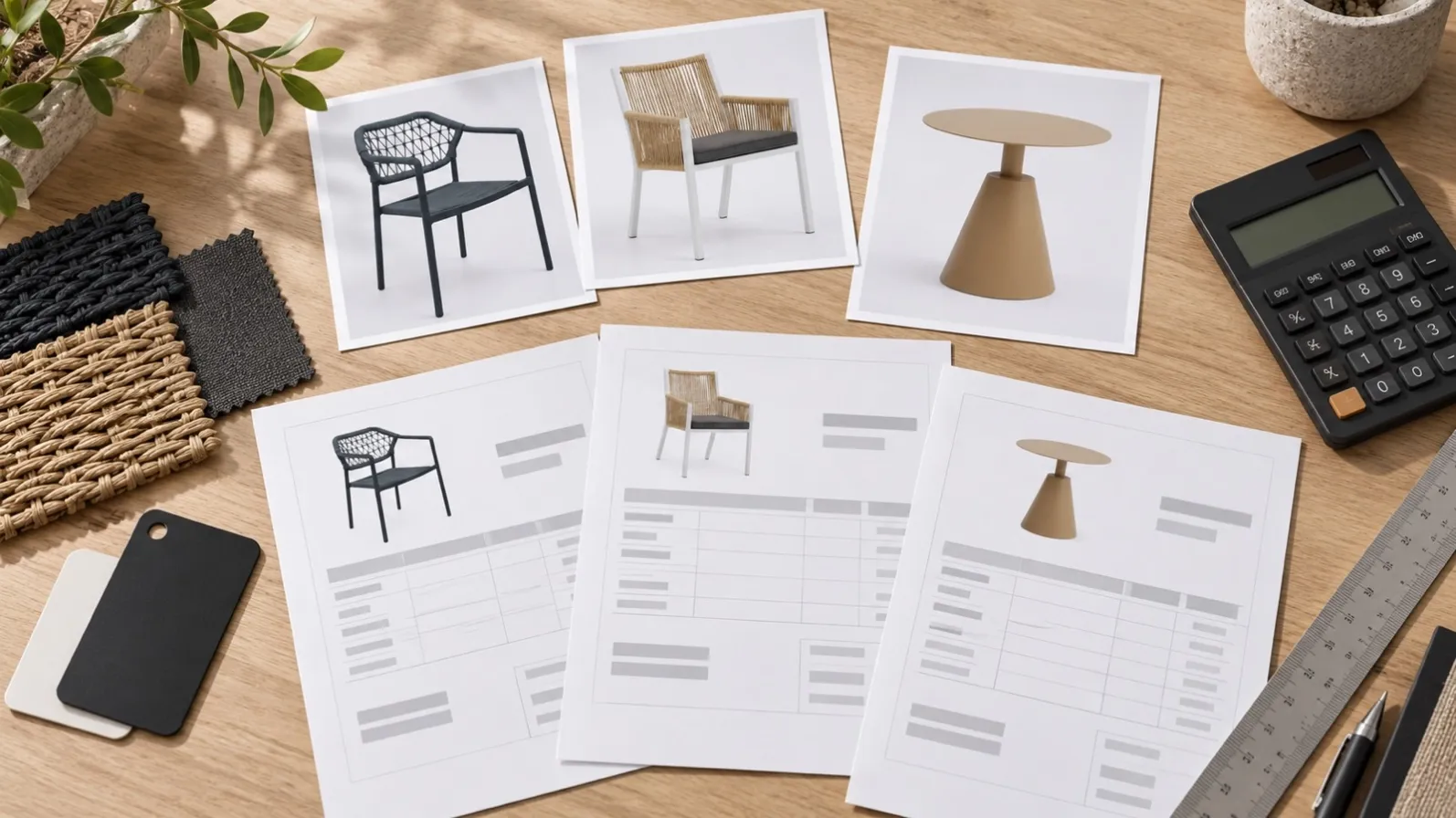
Product reference — Model number, category, marked photo or reference image — Reduces the risk of quoting a visually similar but different item
Application — Restaurant terrace, hotel courtyard, poolside, garden retail or other defined use — Guides material and construction questions
Estimated quantity — Quantity by model, not only one total number — Supports quotation and packing review
Material and finish — Known frame, surface, color and cushion preferences — Separates fixed requirements from alternatives
Destination — Country and port or named delivery place — Makes delivery assumptions visible
Required options — Cushions, tables, covers, labels, spare parts or coordinated items — Prevents optional items from being overlooked
Approval process — Required sample, swatch, drawing, photo or record — Establishes how the final specification will be confirmed
Timing — Target project or buying window, clearly marked as a request — Allows lead-time factors to be discussed without inventing a promise
Unknown information does not need to be guessed. Mark it as supplier to propose or to be confirmed after sample review so every quotation uses the same assumption.
Identify products without creating model confusion
Use the supplier's current model number when one is available. Add a marked image if the product has several similar versions. For a coordinated collection, use one line for each chair, table, sofa module, lounger or accessory instead of placing the full project in one description.
A practical product line can contain:
• product category and model number;
• reference image filename;
• required quantity;
• preferred frame and surface appearance;
• cushion or tabletop requirement;
• required color reference;
• application zone;
• buyer notes and open questions.
If only a reference photo is available, state whether it is an appearance reference or a construction requirement. A photo cannot confirm tube specification, surface material, dimensions, packing or performance.
Describe the application and operating environment
The phrase outdoor use is too broad for a purchasing specification. A restaurant team that moves chairs every day, a poolside operation exposed to water and cleaning chemicals, and a covered hotel courtyard have different handling and maintenance questions.
Tell the supplier about:
• commercial or residential intensity;
• covered or fully exposed placement;
• sun, humidity, rain, salt air or poolside exposure;
• daily moving, stacking or seasonal storage;
• cleaning routine and access requirements;
• cushion drainage and storage expectations;
• local accessibility or project-design requirements.
This information does not replace a written material specification, but it helps the buyer ask the right questions before sample approval.
Separate fixed requirements from supplier proposals
Create three columns in the RFQ: required, preferred and supplier to propose. This prevents a color inspiration image from being treated as an exact specification and prevents an optional suggestion from appearing as a mandatory cost.
Requirement type — Example
Required — Product category, quantity, destination and approved model reference
Preferred — Visual color direction, weave appearance or cushion style
Supplier to propose — Suitable models, coordinated side tables or alternative surface options
When alternatives are allowed, ask the supplier to identify every difference from the requested reference. Alternatives should not be silently substituted into the quotation.
Ask for a quotation that can be compared
A low unit price is not comparable when another quotation includes different materials, cushions, packing or delivery responsibility. Request a line-by-line response showing:
• quoted model and description;
• included and excluded components;
• material and color assumptions;
• quantity basis;
• packing basis when available;
• sample or approval requirements;
• commercial terms that still need confirmation;
• the exact Incoterms rule, named place and version when used.
The International Chamber of Commerce explains that Incoterms rules allocate delivery tasks, costs and risks between seller and buyer. An RFQ should therefore avoid writing only FOB or CIF; the named port or place and the agreed rule version should be recorded in the commercial discussion.
Plan sample and specification approval
The RFQ should state how approval will be recorded. Depending on the product, the review may involve a physical sample, material swatch, color reference, dimensions, marked photos, packaging proposal or signed specification sheet.
Before approving a sample, compare:
• model number and product structure;
• dimensions and usable clearances where relevant;
• frame finish and visible color;
• rope, rattan, mesh or other surface construction;
• cushion appearance and drainage approach;
• tabletop, hardware and coordinated components;
• underside, attachment points and contact areas;
• proposed packing and product identification.
Unconfirmed values such as MOQ, production lead time, loading quantity, testing and warranty should remain open questions until the supplier provides order-specific information.
Common RFQ problems and how to prevent them
Problem — Result — Better approach
One total quantity for many products — The supplier cannot see the quantity basis per model — List quantity on every product line
Reference image without explanation — Appearance and construction may be confused — Mark what the image is intended to show
No destination — Freight and delivery assumptions remain unclear — Add country, port or named place
Material names without a sample reference — Quotations may use different constructions — Request written specification and swatch or sample review
Same as photo — Important details remain undefined — Record dimensions, finish, surface and components separately
Missing exclusions — Optional cushions or tables may be assumed — Ask what is included and excluded
Unclear approval process — Sample-to-order changes become difficult to track — Define approval records before productionProduct categories to include in the request
Buyers can build the RFQ from the current DM Furniture category pages:
• outdoor dining chairs: https://www.dmfurnitures.com/outdoor-dining-chairs• outdoor sofa sets: https://www.dmfurnitures.com/outdoor-sofa-sets• outdoor tables: https://www.dmfurnitures.com/outdoor-tables• outdoor bar chairs: https://www.dmfurnitures.com/outdoor-bar-chairs• outdoor hanging chairs: https://www.dmfurnitures.com/outdoor-hanging-chairs• sun loungers and beach chairs: https://www.dmfurnitures.com/sun-loungers-beach-chairs
For multi-zone hospitality sourcing, review the commercial outdoor furniture application ideas: https://www.dmfurnitures.com/applications before making the product list.
Copy-ready RFQ checklist
• Company, market and buyer type
• Project or collection name
• Product category and model number for each line
• Marked reference images where needed
• Estimated quantity by model
• Application zone and outdoor exposure
• Required, preferred and supplier-proposed details separated
• Frame, surface, color and cushion preferences
• Required accessories or coordinated products
• Destination country, port or named place
• Requested Incoterms rule, named place and version
• Sample and specification approval requirements
• Packing, labeling and documentation questions
• Open questions clearly marked for confirmation
FAQ
Can I request a quotation without model numbers?
Yes. Send marked reference images, product categories, application, quantity estimate and destination. State which details are appearance references and which are required.
Should I ask for MOQ and lead time in the first RFQ?
Yes, but treat the response as category- or order-specific. Do not assume that one MOQ or lead time applies to every model, material and season.
Do I need exact quantities before contacting a supplier?
An estimate is enough to start, provided it is separated by model or category and clearly identified as an estimate.
Why should cushions and tables be separate lines?
Separate lines show what is included, simplify alternatives and reduce confusion when a seating model is offered with different cushions or coordinated tables.
What should I send when I need a coordinated hotel or resort collection?
Send a zone list, reference images, required categories, estimated quantity by zone, preferred appearance and destination. The supplier can then review the collection as connected product groups.
RFQ CTA
Send your outdoor furniture RFQ: https://www.dmfurnitures.com/contact-us with model numbers or reference images, estimated quantity by product, application environment, preferred materials and colors, destination, and any required coordinated categories.
External sources
• ICC Incoterms 2020 resources: https://library.iccwbo.org/content/tfb/BOOKS/BK_0049/BK_0049_07_PubAndResources.htm• Google people-first content guidance: https://developers.google.com/search/docs/fundamentals/creating-helpful-content
The ICC source supports the explanation of delivery obligations only. Order-specific terms must be agreed by buyer and seller.