Sep 8, 2026Buying Guides
How B2B Buyers Should Review an Outdoor Furniture Workshop
Review an outdoor furniture workshop through model records, frame preparation, weaving, assembly, inspection evidence, finished-goods handling and sample traceability.

Direct answer
A useful outdoor furniture workshop review should connect visible production activity to one traceable product specification. Ask how model numbers, drawings, materials, colors and approved samples move from quotation into frame preparation, surface work, weaving, assembly, checking and finished-goods handling. Factory photos can show that a process or product group exists, but they cannot prove capacity, certification, test results or order quality by themselves. Compare the workshop evidence with the exact models being sourced, request records for the required inspection points, and keep all unconfirmed production, packing and performance claims outside the public specification until they are documented.
What buyers should verify
- Does each shortlisted product have one current model identity and written specification?
- How are approved colors, materials and samples identified during production?
- Which operations are completed in the visible workshop and which are sourced externally?
- How are frame, surface and woven components checked before assembly?
- How are changes from sample to production recorded?
- Which in-process and final checks apply to the exact order?
- How are finished items identified and protected before packing?
- Which packing and labeling instructions are order-specific?
- What evidence is available for any requested test, certificate or inspection?
- Who is responsible for resolving specification differences before shipment?
Start with identity and document control
The workshop review starts before the production floor. A model number, product image and title must refer to the same construction. The order file should separate confirmed facts from buyer preferences and supplier proposals.
Record — Minimum review point — Risk if missing
Product identity — Model, current image and category agree — A similar product may be quoted or produced
Written specification — Frame, surface, finish, components and approved dimensions — Visual references remain open to interpretation
Approval evidence — Sample, swatch, marked photo or signed record — Production changes are difficult to trace
Change record — Difference, approval date and responsible person — Sample and order may silently diverge
Inspection plan — Checkpoint, method and acceptance requirement — Final inspection may not match buyer priorities
Packing instruction — Product identification and protection requirements — Correct goods may be difficult to identify or protect
This is why model identity must be corrected before quotation: a product title, badge, image and written specification should never point to different items.
Read factory images as evidence, not proof of everything
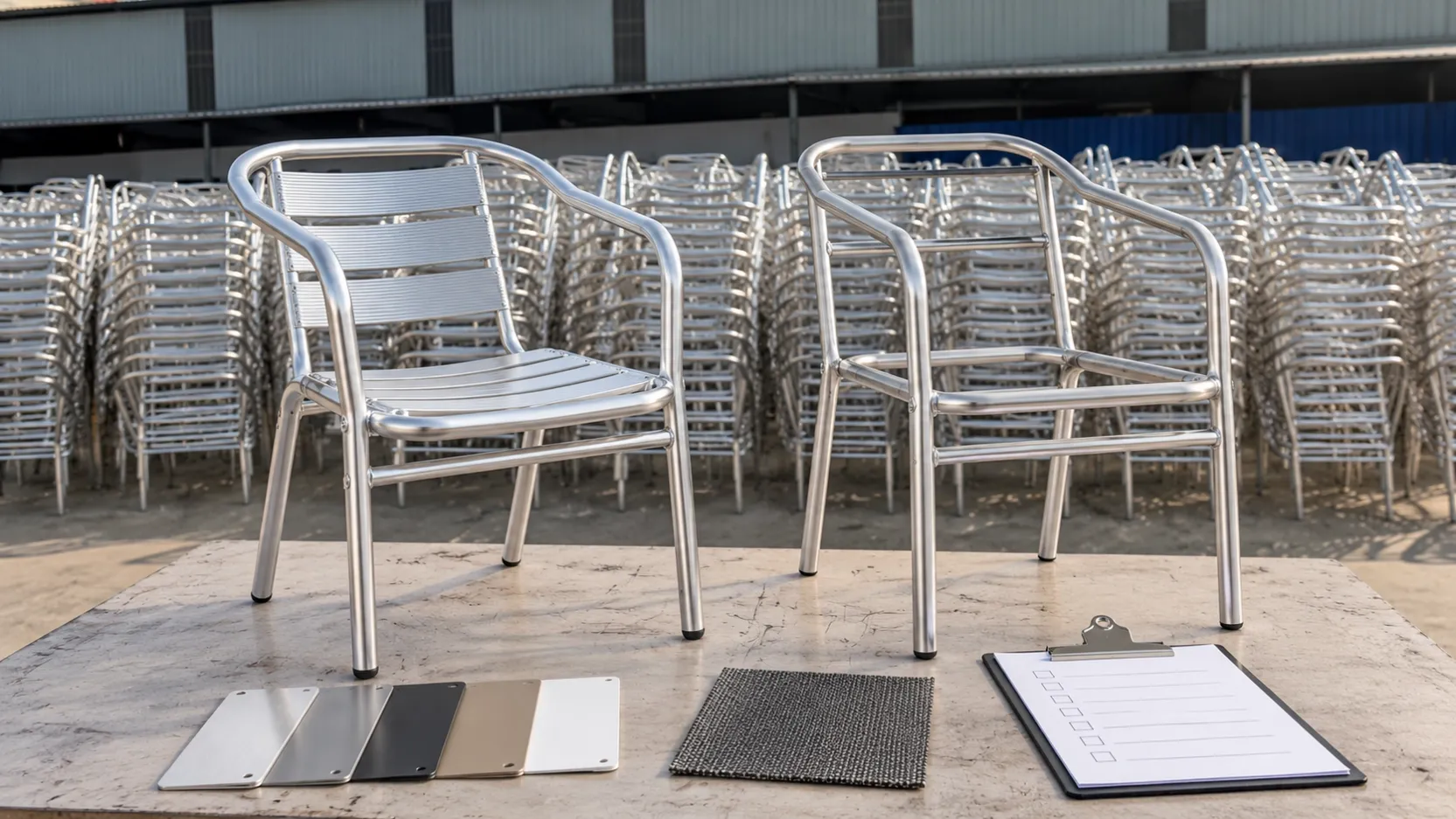
DM Furniture has provided owned images showing grouped metal chair frames, woven dining-chair work, woven sofa work, finished chairs, covered product groups and showroom displays. These images support only what is visible.
Visible image evidence — Safe interpretation — What it does not prove
Grouped bare chair frames — Frame preparation or storage context is visible — Alloy grade, tube thickness, weld quality or capacity
Workers weaving chairs or sofas — Manual weaving activity is visible — Material specification, output rate or inspection result
Finished chairs grouped in a workshop — Finished-product handling context is visible — Order quantity, stock ownership or shipment readiness
Covered product groups — Protective covering before later handling is visible — Final packing specification or completed shipment
Showroom samples — Product comparison and appearance review are possible — Current supply, approved color or contract specification
Avoid captions such as
quality-certified production, ready to ship or large stock unless the supporting record exists.Frame preparation and surface questions
The buyer should ask for the exact frame material and construction used by the shortlisted model. A bare-frame photo cannot establish alloy, wall thickness, weld preparation, surface treatment or coating performance.
Useful review questions include:
• Which frame record belongs to the quoted model?
• How are components identified before and after surface work?
• Which visible joints or contact areas are checked?
• How is the approved finish reference communicated?
• How are rework and appearance differences recorded?
• Which order-specific test or inspection requirement applies?
Do not use the broad phrase
outdoor finish as a substitute for a confirmed specification.Weaving and assembly questions
Owned production images show manual weaving on dining chairs and a sofa body. For a buyer, the useful question is not simply whether weaving occurs, but how the approved material, pattern, tension, edge treatment and frame are identified for the order.
Review the physical sample or approved evidence for:
• material and color reference;
• visible pattern and spacing;
• edge termination and attachment areas;
• contact points between surface and frame;
• symmetry and appearance on comparable units;
• cushion or removable-component fit when included;
• changes required before production approval.
The outdoor furniture material guide: https://www.dmfurnitures.com/blog/outdoor-furniture-material-notes-b2b-buyers helps organize material questions, but the order still needs a model-specific record.
Define inspection instead of writing a generic QC claim
QC is not one universal check. Buyer and supplier should agree which characteristics matter, when they are checked, how the sample is selected and how results are recorded. Depending on the order, review may cover identity, dimensions, appearance, stability, moving parts, components, labels and packing.ISO's supplier guidance explains that buyers remain responsible for making their needs clear through specifications, drawings, standards, catalogues or other documents. ISO also publishes acceptance-sampling standards for coordinated supplier, customer and third-party inspection. These sources are useful planning references; they do not mean DM Furniture holds an ISO certificate or that one sampling plan fits every order.
Finished-product handling and packing review
Finished items should remain connected to their model and approval record. Ask how mixed colors, similar versions and optional cushions are separated. Review protection at legs, arms, woven surfaces, tabletops and other contact areas according to the exact packing proposal.
Loading quantities and packing dimensions vary by model and order configuration. They should remain order-specific information supplied during quotation follow-up, not generic website claims.
Prepare a remote workshop review
When an on-site visit is not practical, request evidence around one shortlisted model rather than a general factory tour.
- Send the model and required specification before the call.
- Ask to see the current model reference and relevant material records.
- Follow the visible sequence from components to finished item.
- Request close views of identified checkpoints, not only wide workshop scenes.
- Record open questions and responsible follow-up.
- Compare the evidence with the approved sample or product record.
- Keep commercial and shipment claims pending until documented.
Common review mistakes
Mistake — Risk — Better approach
Treating a busy workshop photo as capacity proof — An unsupported numerical claim is created — Request dated, order-relevant records
Reviewing a similar chair instead of the quoted model — Construction differences are missed — Use one current model identity throughout
Asking whether the factory has QC — The answer remains generic — Define checkpoints and acceptance requirements
Assuming covered goods are packed orders — Handling stage is misrepresented — Caption only what is visible
Copying a certificate claim from another source — Legal and trust risk — Verify certificate owner, scope and validity
Publishing packing or loading estimates — Values may be wrong for the order — Confirm them privately by model and order
Buyer checklist
• Current model, image, title and category agree
• Written specification is available for the shortlisted model
• Required, preferred and supplier-proposed details are separated
• Sample or swatch approval is recorded
• Workshop evidence relates to the exact product or process discussed
• Frame and surface questions are model-specific
• Weaving and assembly checkpoints are defined
• Inspection requirements and records are agreed
• Similar versions and colors can be traced
• Finished-item protection is reviewed
• Packing and logistics remain order-specific
• Certificates and tests are verified before any claim is made
FAQ
Do factory photos prove manufacturing capacity?
No. They show visible facilities, products or operations at one moment. Capacity needs dated, relevant and verified operational evidence.
What should a buyer ask to see during a remote factory review?
Use one shortlisted model and ask to see its current specification, material references, relevant operations, inspection points, finished identification and open-change records.
Does this article claim that DM Furniture is ISO certified?
No. ISO resources are cited as purchasing and inspection-planning references only. No certification claim is made.
Which product details are provided after inquiry?
Order-specific information such as MOQ, lead time, packing, loading, testing and warranty should be confirmed for the selected models and quantity.
What company facts are approved for public use?
DM Furniture was established in 2002, works with more than 100 skilled professionals and operates across a 10,000-square-meter factory area.
RFQ CTA
Send a product and factory-review RFQ: https://www.dmfurnitures.com/contact-us with the model numbers or references, estimated quantity, application, preferred materials and colors, destination, and the evidence or inspection points required by your team.
External sources
• ISO guidance for buyers evaluating ISO 9001 suppliers: https://www.iso.org/iso/pub100304.pdf• ISO 28598-2 acceptance sampling overview: https://www.iso.org/standard/69416.html• Google people-first content guidance: https://developers.google.com/search/docs/fundamentals/creating-helpful-content
These sources support process and evidence planning only. They do not create an ISO certification, product-test or quality-performance claim for DM Furniture.