Sep 2, 2026Buying Guides
How to Source Stackable Outdoor Dining Chairs for Restaurants
Evaluate stackable outdoor dining chairs by exact model, stack contact points, stability, handling, table fit, storage, maintenance and order-specific testing.

Direct answer
Choose stackable outdoor dining chairs by checking the exact model in a real stack, not by relying on a category label or similar product photo. Review stack stability, maximum approved stack arrangement, contact points, finish protection, staff grip areas, chair weight when confirmed, arm and table clearance, occupied comfort, floor contact and storage route. Ask the supplier to record whether the quoted model is designed for stacking and which test or inspection requirement applies to the target market. A chair that nests visually may still damage its finish, become unstable or create an impractical lifting task during daily restaurant operations.
Questions for the buyer and operator
- How often will staff stack, move and unstack the chairs?
- Is stacking for daily cleaning, event resets, seasonal storage or freight handling?
- What is the exact model and approved stack arrangement?
- Which parts touch when chairs are stacked?
- Can staff grip and lift the chair without using woven or decorative surfaces?
- How much storage height and floor area are available?
- Which route, doorway and floor changes lead to storage?
- Does the chair fit the selected table when occupied and stored nearby?
- Which finish, surface and cushion details need approval?
- Which safety, stability and performance requirements apply in the destination market?
Confirm that the exact model is stackable
Do not call every dining chair stackable. Ask the supplier to identify the exact model, show the intended nesting direction and state the proposed stack arrangement. Product photographs of grouped chairs can demonstrate how particular frames are handled, but they do not establish a universal stacking limit.
Evidence — What to check — What remains unconfirmed
Single product image — Arm, back, leg and seat form — Whether another chair nests safely
Small physical stack — Contact points and alignment — Approved operational stack size
Larger stack demonstration — Stability and staff access — Performance after repeated use
Written model record — Stackability statement and components — Order-specific test or inspection result
Operator trial — Lifting, route and storage practicality — Long-term finish wear
If the model has a cushion, confirm whether it remains in place, is removed before stacking or needs separate storage.
Inspect stack contact points
When one chair touches another, the load may pass through the frame, glides, arms, seat edge or a protective spacer. The buyer should inspect these areas on the approved sample.
Look for:
• frame-to-frame or surface-to-surface contact;
• protection between coated parts;
• pressure on rope, rattan, Textilene or cushion components;
• alignment of front and rear legs;
• stability on a level storage surface;
• projections that may catch clothing or adjacent chairs;
• finish marks after repeated stacking trials.
Do not assume that a high stack is better. The practical arrangement must suit the chair, staff, storage area and supplier's confirmed guidance.
Review staff handling and storage route
Daily restaurant operation turns a product feature into a repeated manual task. Ask the operator who moves the chairs, how far they travel and whether carts or other handling equipment are used. Review doorway widths, turns, ramps, level changes and the final storage footprint.
A useful trial includes:
- moving one chair from the dining position;
- building the proposed operational stack;
- checking balance and grip areas;
- moving the stack only by the approved method;
- storing it without blocking access or services;
- unstacking and checking the finish and surfaces.
The project team remains responsible for workplace safety and local handling requirements.
Keep dining comfort and table fit in the decision
Stackability should not override the primary dining function. Review seat and arm form, occupied depth, table height, apron clearance, table-base legroom and guest spacing using confirmed dimensions.
The commercial outdoor dining furniture sourcing guide: https://www.dmfurnitures.com/blog/outdoor-dining-furniture-sourcing-notes explains how to approve the chair and table as one system. If a terrace also uses bar-height seating, review the separate bar chair and high-table guide: https://www.dmfurnitures.com/blog/match-outdoor-bar-chairs-with-high-tables.
Compare surfaces and maintenance requirements
Outdoor dining chairs may combine aluminum frames with rope, rattan-style weaving or Textilene surfaces. The material category alone does not mean every model is stackable or uses the same construction.
Surface area — Stack-related question — Maintenance question
Coated frame — Where do frames touch? — How should marks and chips be reported?
Rope or woven area — Is pressure applied while nested? — What cleaning and drying method is proposed?
Textilene or sling — Does the next chair contact the surface? — How are tension and edge areas checked?
Cushion — Is it removed before stacking? — Where is it dried and stored?
Feet and glides — Do they align in the stack? — Are replacements identifiable?
Request model-specific care instructions. Avoid generic
easy maintenance claims without a defined material and procedure.Define sample, inspection and test requirements
The buyer should state the destination market, commercial use and any applicable standards or client requirements in the RFQ. Ask for evidence that relates to the exact model and current construction. A certificate or test for a similar chair must not be presented as evidence for the quoted model.
Recent U.S. CPSC outdoor restaurant-chair recalls illustrate why model identity, structural performance and traceability matter in commercial seating. They do not concern DM Furniture and are not evidence about any DM model; they are cited only as a procurement-risk example.
During sample review, record:
• exact model and construction;
• dimensions and components;
• intended stack arrangement;
• contact points after repeated handling;
• stability and visible condition;
• table pairing and occupied comfort;
• required destination-market tests or inspections;
• approved changes before production.
Packing is not the same as operational stacking
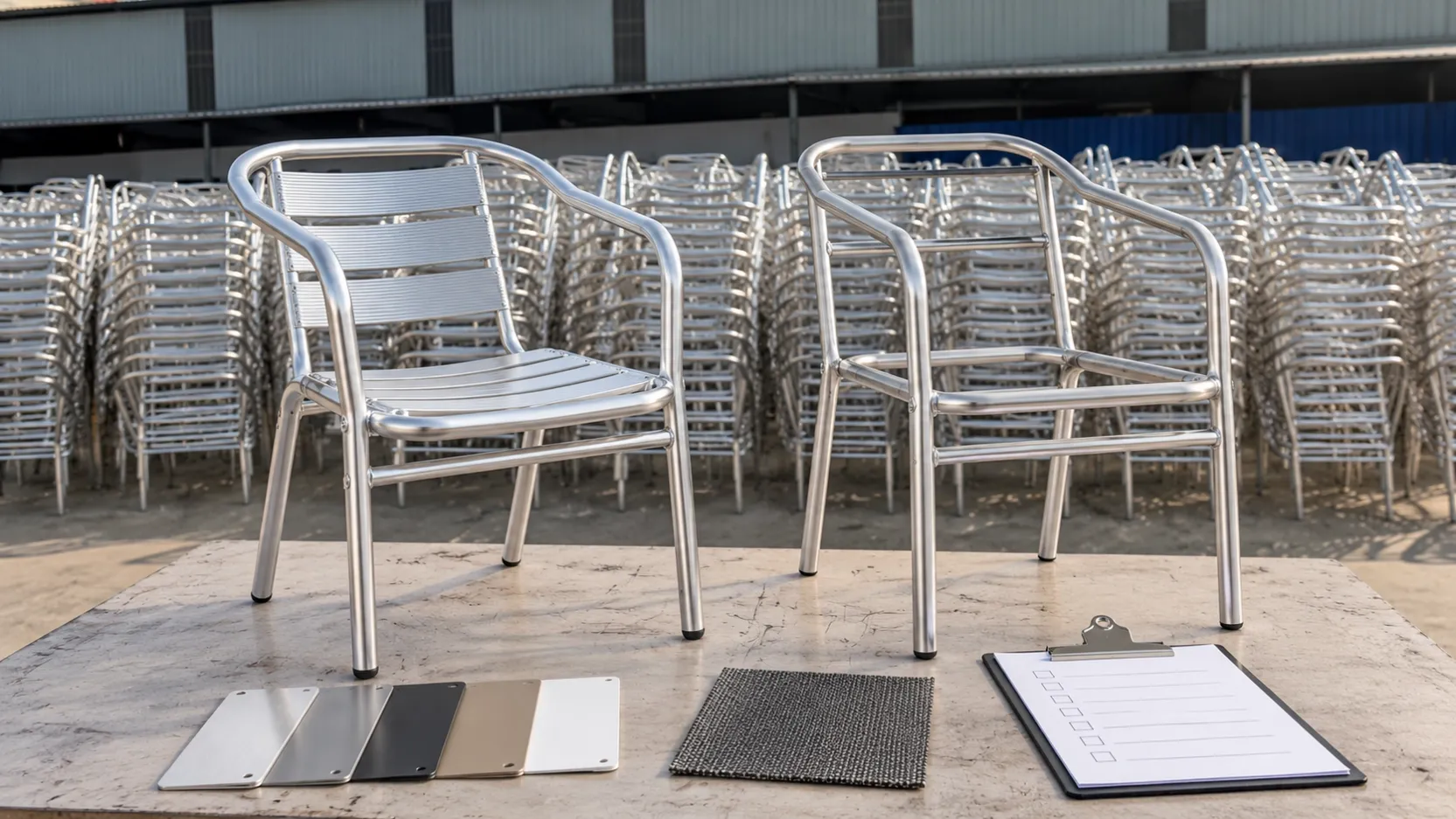
Chairs may be inverted, nested or protected differently for packing than for daily restaurant storage. Do not infer an operational stack limit from a warehouse or packing image. Ask the supplier to separate:
• restaurant stacking guidance;
• internal workshop handling;
• order packing configuration;
• container-loading information.
Packing dimensions and loading quantities should be confirmed privately for the selected model and order rather than inferred from public images.
Common sourcing mistakes
Mistake — Risk — Better approach
Calling a similar chair stackable — Model mismatch — Verify the exact quoted model
Maximizing stack height without a trial — Instability or difficult lifting — Approve an operational arrangement
Ignoring contact points — Finish or woven-surface damage — Inspect repeated stacking marks
Selecting for storage only — Poor dining comfort or table conflict — Approve occupied use and storage together
Treating warehouse nesting as restaurant guidance — Packing and operation are confused — Request separate instructions
Using a test report for another model — Unsupported compliance claim — Match evidence to model and construction
Buyer checklist
• Exact model and current image agree
• Supplier confirms the model is intended for stacking
• Proposed operational stack arrangement is recorded
• Contact points and finish protection are inspected
• Grip areas and staff handling are trialed
• Storage route and footprint are measured
• Cushions and removable parts have a storage plan
• Dining comfort and table clearance are approved
• Frame, surface and finish records are confirmed
• Destination-market requirements are stated
• Tests and certificates match the exact model
• Packing and operational stacking remain separate
FAQ
How many outdoor dining chairs can be stacked?
There is no safe universal number. Ask for the exact model's approved arrangement and verify it against staff handling, storage and stability requirements.
Are all aluminum dining chairs stackable?
No. Frame material alone does not determine nesting geometry, contact points or stability.
Should cushions remain on the chairs when stacked?
Only if the exact model and supplier guidance support it. Otherwise cushions may need removal, drying and separate storage.
Can a warehouse photo prove restaurant stackability?
No. It shows one handling or storage state. Restaurant operation requires its own model-specific review.
What should be included in an RFQ for stackable chairs?
Include the exact model or reference, application, quantity, destination, table pairing, materials and colors, daily handling routine, storage constraints and required test or inspection evidence.
RFQ CTA
Send a stackable dining-chair RFQ: https://www.dmfurnitures.com/contact-us with the model or reference image, application, estimated quantity, selected tables, materials and colors, destination, daily stacking routine and storage requirements.
External sources
• U.S. CPSC 2026 outdoor restaurant-chair recall: https://www.cpsc.gov/Recalls/2026/Clark-Associates-Recalls-Lancaster-Table-Seating-Powder-Coated-Aluminum-Outdoor-Restaurant-Chairs-and-Barstools-Due-to-Fall-Hazard• Google people-first content guidance: https://developers.google.com/search/docs/fundamentals/creating-helpful-content
The CPSC source is a general procurement-risk example. It does not concern DM Furniture or establish the test status of any DM Furniture model.