Sep 1, 2026Buying Guides
How to Evaluate an Outdoor Furniture Manufacturer: A B2B Checklist
Evaluate an outdoor furniture manufacturer through product records, samples, production evidence, QC, packing and communication before placing a commercial order.

Direct answer
Evaluate an outdoor furniture manufacturer by checking whether product identity, material specifications, sample records, production evidence, inspection points, packing plans and commercial communication remain consistent from RFQ to shipment. A large catalogue or polished website is not enough. Start with a small, traceable shortlist and ask the supplier to show how each model moves from source record to sample, production, QC and packing. Strong evidence is specific: matching model numbers and images, written material details, dated approvals, clear responsibility for changes, and records that allow a buyer to compare the approved sample with mass production.
Buyer questions to answer before shortlisting a supplier
- Does the supplier understand the buyer type, market and application?
- Are model numbers, titles, images, materials and categories consistent?
- Which product facts are verified and which still require confirmation?
- Can the supplier explain the production steps relevant to the selected model?
- How is the approved sample recorded and compared with mass production?
- Which material, in-process and final checks are documented?
- How are changes to color, weaving, fabric, hardware or packing approved?
- Can the supplier show owned, relevant factory and product evidence?
- How are packing protection and model identification reviewed?
- Are MOQ, lead time, CBM and loading details tied to the exact product and packing method?
- Who communicates technical questions and who confirms commercial changes?
- What will happen if a fact conflicts across the quotation, sample and order documents?
Decision summary
Evaluation area — Strong evidence — Warning sign
--- — --- — ---
Product identity — Same model, title, image, material and category across records — Similar products substituted or model numbers change without explanation
Specifications — Written, model-specific fields with unknowns clearly marked — Broad phrases such as high quality material without a specification
Sample control — Dated sample approval with photos, colors and change record — Approval depends on chat messages or a single beauty photo
Manufacturing — Relevant process photos and an explained sequence — Generic factory images unrelated to the selected product
QC — Defined checks and records at appropriate stages — Only 100% quality claims with no method or evidence
Packing — Model-specific protection and identification plan — Packing discussed only after production is complete
Communication — Clear owner, revision history and written confirmation — Important changes remain scattered across messages
Commercial data — MOQ, CBM, lead time and loading tied to the approved configuration — Values copied from another model or quoted before packing is defined
- Verify product identity before discussing scale
Start with a controlled shortlist rather than a large mixed catalogue. For each model, compare:
• model number and product name;
• category and intended application;
• main image and detail images;
• frame and surface materials;
• set composition where applicable;
• current supply status;
• the source and date of the information.
If the supplier cannot keep these fields aligned for a small shortlist, adding more SKUs will magnify quotation and order risk. A mismatch does not always mean the supplier is unreliable; it may be an old/new model, color variant or data-entry problem. What matters is whether the conflict is recorded and resolved rather than silently overwritten.
- Separate verified facts from pending facts
A professional supplier should be able to say not yet confirmed. Unknown MOQ, packing size or loading quantity is safer than a confident number copied from a different model.
Ask the supplier to distinguish:
• facts verified from the current product record;
• values that depend on final color, cushion, tabletop, set composition or packing;
• factory confirmations still required;
• buyer decisions still open;
• information that is internal and should not appear on a public page.
This distinction also improves quotation comparison. Two quotations are not comparable when one uses a confirmed configuration and the other uses assumptions.
- Match manufacturing evidence to the selected product
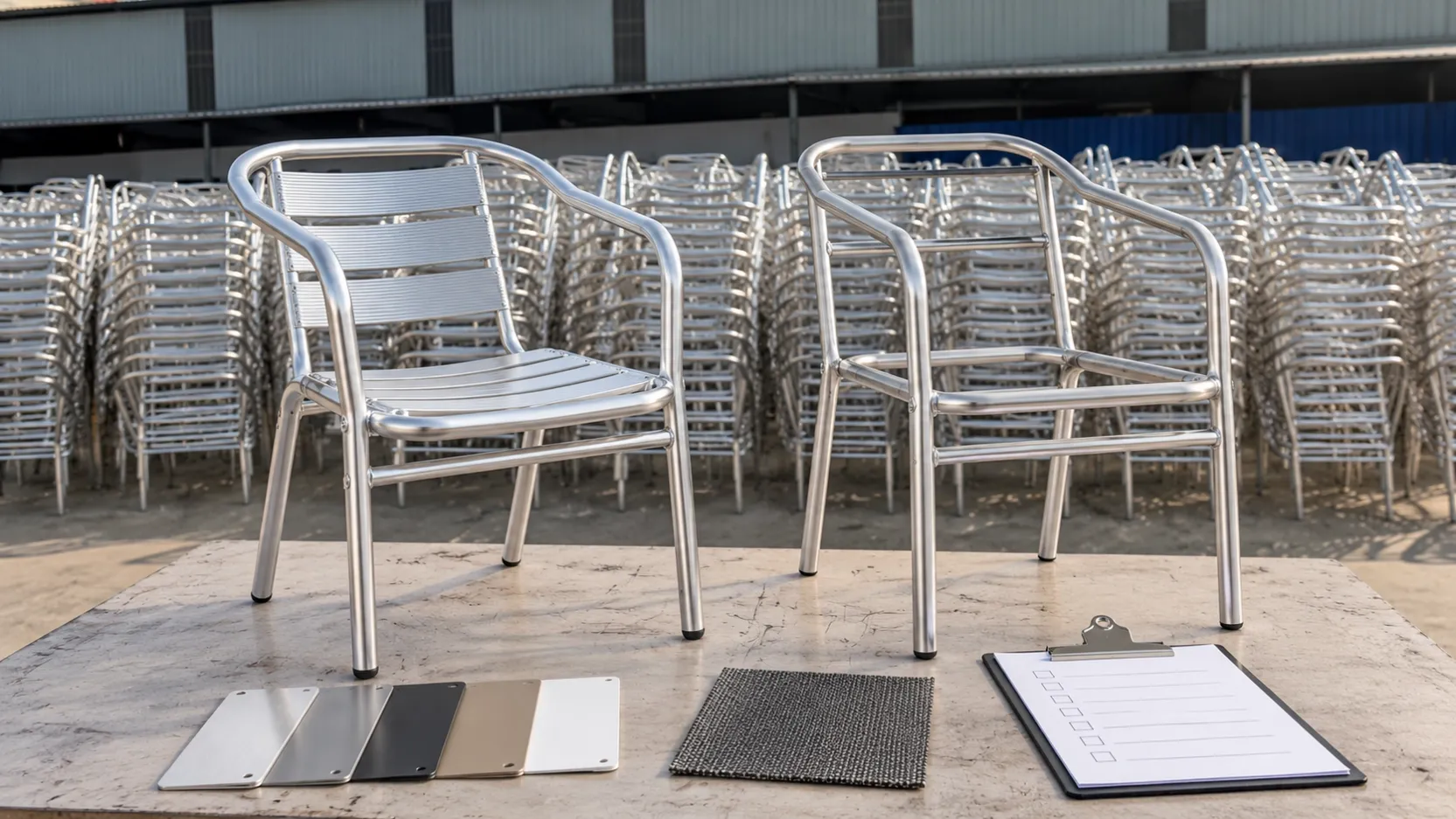
Factory images are useful only when they help explain a real step. For an aluminum-frame woven chair, relevant evidence may include frame preparation, welding or joint finishing, coating/finish review, weaving, assembly, final inspection and packing. Not every supplier will publish every step, but the buyer should understand which operations are controlled and which evidence can be shared.
DM Furniture has owned images showing workshop production, woven-chair work, material/frame areas, finished products, showroom samples and covered products awaiting packing. Public captions must describe only what is visibly supported. The full process sequence and QC checkpoints remain MISSING—NEEDS CONFIRMATION until approved.
- Treat sample approval as a controlled record
The sample is not just a sales object. It should become the reference for mass production.
The approval record can include:
• model and revision;
• dated overall and detail photos;
• frame color reference;
• rope, rattan, mesh or fabric reference;
• cushion and tabletop details when applicable;
• approved changes and responsible person;
• points that remain open;
• packing concept if the sample packing differs from mass production.
Before production, both parties should know which sample details are fixed and which can change. Before shipment, inspection should compare the relevant production details with the same record.
- Ask how quality will be evaluated
Quality becomes useful only when connected to a check. Depending on the product, buyers may need to review:
• frame geometry and stability;
• welding and joint finishing;
• coating appearance and protected contact areas;
• weave pattern, tension, terminations and color consistency;
• mesh or fabric alignment and fixation;
• cushion appearance and drainage-related construction;
• hardware, glides and moving parts;
• product cleanliness and model identification;
• packing protection and carton condition.
The exact test method, sampling level and acceptance criteria must be agreed for the order. This article does not claim that DM Furniture performs an unverified test or uses an unconfirmed standard.
- Review packing before production is finished
Packing affects surface protection, handling, CBM, loading and landed cost. It should not be treated as a last-minute warehouse task.
Ask:
• Is the product stacked, knocked down or carton packed?
• Which surfaces and contact points need protection?
• How are legs, arms, tabletops and woven surfaces separated?
• How is moisture risk handled?
• How are model, color and quantity identified?
• Does the packing method change CBM or assembly responsibility?
• Is the loading value based on this exact approved packing method?
DM Furniture's exact public packing, CBM and loading details remain private and model-specific until confirmed.
- Evaluate communication discipline
Good communication is not measured only by reply speed. It should leave a clear record.
For a meaningful RFQ, the buyer should provide product models or reference images, estimated quantity, destination, application environment, preferred materials/colors, required categories and project timing. The supplier should identify assumptions, open questions and any conflict between sources.
Changes to product, color, set composition, sample or packing should be written into the current quotation or approval record. A messaging thread alone is easy to misread after several revisions.
Practical supplier-evaluation checklist
• Supplier understands the target market and application.
• Five to ten shortlisted models have consistent identity records.
• Product images and materials match the model number.
• Unknown facts are clearly separated from verified facts.
• Relevant process evidence is available and owned by the supplier.
• Sample approval fields and change control are defined.
• QC checks are connected to the selected product.
• Packing is reviewed before mass production is complete.
• MOQ, CBM, loading and lead time are model/configuration specific.
• One current document records commercial and technical revisions.
• The inquiry path reaches a named contact.
• A small order or sample stage can be reviewed before scaling the SKU count.
Relevant DM Furniture resources
• outdoor furniture categories for B2B sourcing: https://www.dmfurnitures.com/products• commercial outdoor furniture application planning: https://www.dmfurnitures.com/applications• DM Furniture company and factory overview: https://www.dmfurnitures.com/about-us• outdoor furniture RFQ contact page: https://www.dmfurnitures.com/contact-us• How to Prepare an Outdoor Furniture RFQ: https://www.dmfurnitures.com/blog/how-to-prepare-outdoor-furniture-rfq
Model-specific examples will be added only after the public-safe shortlist is confirmed.
FAQ
Does a large factory or catalogue prove supplier capability?
No single number or catalogue proves that a supplier can reproduce the selected product. Product consistency, process relevance, sample control, QC evidence and communication records are more useful evaluation signals.
Should a buyer require every parameter before sending an RFQ?
No. An RFQ can begin with models or reference images, application, quantity estimate and destination. The supplier should then identify which technical and packing fields must be confirmed before the quotation becomes comparable.
Can public factory photos replace an audit?
No. Photos can support a preliminary review and help buyers ask better questions. They do not replace a required factory audit, product inspection or order-specific evidence.
How many products should be checked first?
Use a manageable shortlist that represents the intended categories and materials. The exact number depends on the program, but the purpose is to test record consistency and communication before scaling.
When should packing and loading be discussed?
Discuss the intended packing approach early. Final CBM and loading quantities should be based on the exact approved product and packing method, not a visually similar model.
What should happen when sources conflict?
Keep both source values, mark the field for confirmation, identify the responsible reviewer and update the current record after the conflict is resolved. Do not silently choose the more convenient value.
RFQ CTA
Send your product list or reference images, estimated quantity, destination, application and preferred materials so DM Furniture can identify the models and open questions needed for a comparable quotation.
External sources
• Google people-first content guidance: https://developers.google.com/search/docs/fundamentals/creating-helpful-content• Google Search Essentials: https://developers.google.com/search/docs/essentials• EMU materials and maintenance: https://emuamericas.com/product-care• Tropitone product care: https://www.tropitone.com/product-care
These sources informed the evaluation topics only. No competitor claim, test, warranty, production method or commercial term has been attributed to DM Furniture.