Buying Guides
Round or Rectangular Outdoor Tables for a Restaurant Terrace?
Test round and rectangular outdoor tables against actual restaurant service, joining plans, occupied chairs and model evidence before requesting quotes.
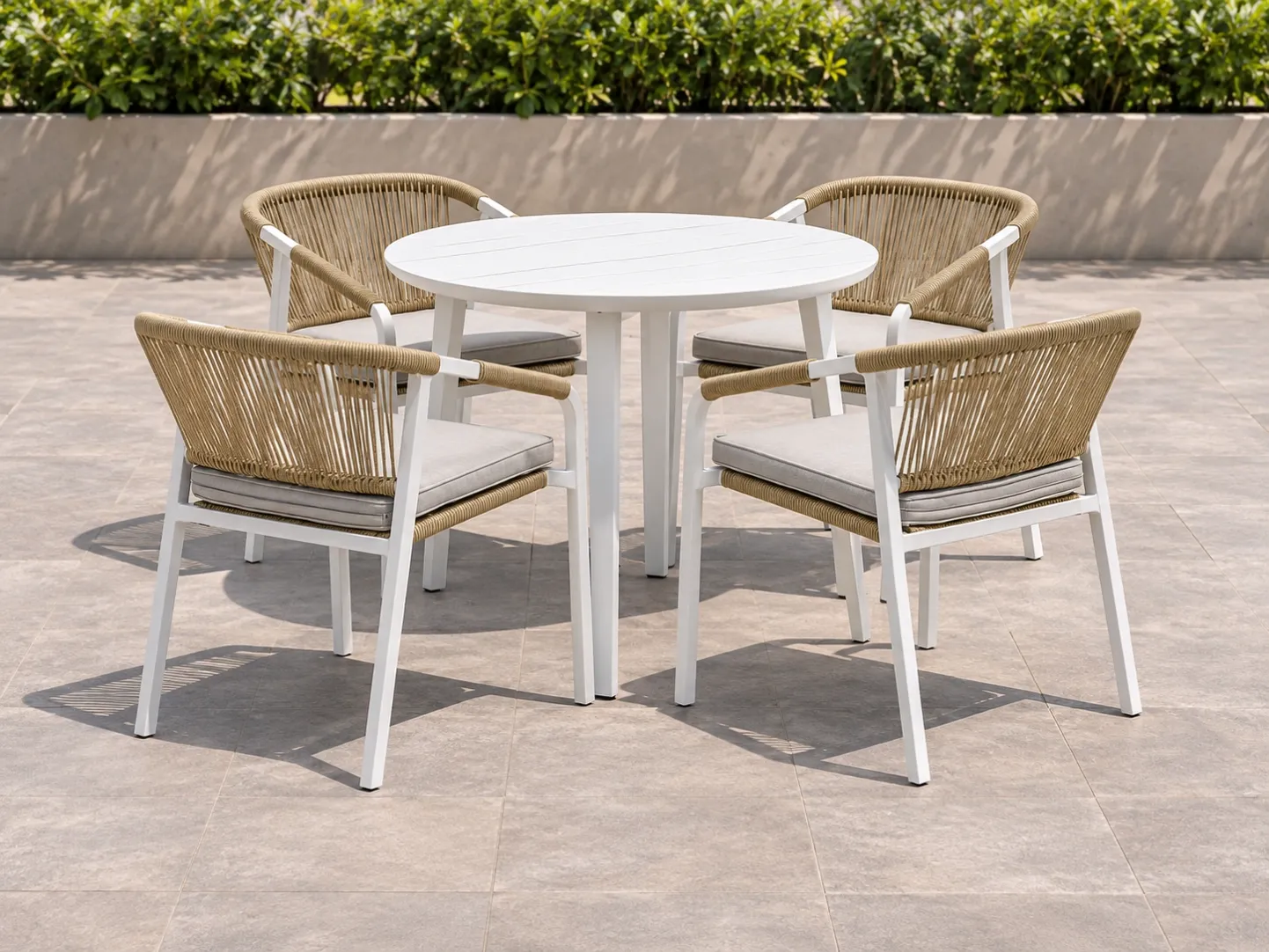
Cover image: Concept visualization based on a DM-owned catalogue photograph. It is not a completed customer project or an exact-model specification.
Direct answer. Choose a round or rectangular outdoor table for a restaurant terrace by testing the venue's real service plan, not by assuming one shape fits more guests. Round tables offer a different guest approach and conversation pattern; rectangular tables can align with a linear zone or a planned group arrangement. Neither shape solves an undersized route or an incompatible chair. Mark table positions, occupied seating, serving side and any need to join tables on a measured plan. Then request current exact-model dimensions, base and chair compatibility before placing a model on the RFQ shortlist.
Define the table's job for each zone
Separate a compact café corner from a long meal-service run or a reservable group area. Note the party sizes the operator actually serves, whether staff join tables, where food is set down and how people approach seats when neighboring tables are occupied. The right outline may differ across zones within one restaurant.
The DM 2026 catalogue shows Kempen D30041-5 with a round table and Gorda D30069-5 with a long table. These images establish visible shape and pictured chairs, not dimensions, materials, table-base construction or current inventory. Do not convert the model-number suffix into a capacity promise. Request current specifications before recommending either exact model.
Test both outlines at occupied scale
Place each candidate outline on the measured floor plan with the actual chairs the operator would use. Mark the chair pull-back area, service route, doorway and any terrace edge or fixed obstruction. Next, place a tray or the venue's usual serviceware at the intended table positions. A top can look generous in an isolated photo while failing the working service test. Record the operator's decision and any unresolved measurement.
For chair arm interference and measurement, use the existing chair/table clearance owner. For tabletop edge concerns, use the table-edge guide. This page owns shape selection for service, not those detailed checks or the separate table-base comparison.
A five-row shape decision sheet
Restaurant question / Round option: record / Rectangular option: record
Normal party / Required place settings and serviceware / Required place settings and serviceware
Group change / Can tables be moved or linked as the operator intends? / Can tables align without blocking seats or routes?
Service / Where can staff approach safely? / Is serving access available along both long sides and ends?
Chairs / Occupied footprint with selected chair / Occupied footprint with selected chair
Approval / Which measured plan and exact model were accepted? / Which measured plan and exact model were accepted?
The completed sheet is a buyer decision record, not a dimensional standard. The venue's site team and local requirements must validate actual access.
Turn the chosen outline into a supplier brief
Specify the preferred shape, candidate model, approved table count, selected chair model or chair dimensions, planned arrangement and destination. Ask for current top/base specification, leg or base placement and actual dimensions. If a grouped arrangement is proposed, request a drawing or dimensioned layout for that exact configuration. Price comparison follows only when the quoted sets contain the same defined components.
Buyer check: Can the chosen shape serve the normal party, accommodate the planned group change, leave occupied routes usable, fit the selected chair and be verified against the current exact-model drawing? If not, return to the layout before increasing quantities.
Frequently asked questions
Are round outdoor tables always better for compact terraces?
No. A small round outline may work in one plan and waste space in another. Test it against the actual walls, routes and occupied chairs.
Can rectangular tables always be joined for larger groups?
No. Joining depends on top, base, height, layout and the operator's plan. Confirm the specific arrangement rather than assuming a pictured table is joinable.
Does a catalogue set photo establish table dimensions?
No. Kempen and Gorda catalogue pages used here are visual references without printed dimensions. Ask for current model-specific drawings and component details.
Should we select the chairs after the table shape?
Check them together. A table outline that works alone may fail once the selected chairs are occupied or pulled back.
CTA: Review Outdoor Tables and Outdoor Dining Chairs, then send a measured layout and exact-model shortlist through Contact.