Outdoor Furniture Assembly Instructions: A Buyer Review
Review outdoor furniture assembly instructions before shipment by checking exact-model identity, parts, tools, steps, diagrams and completion checks.
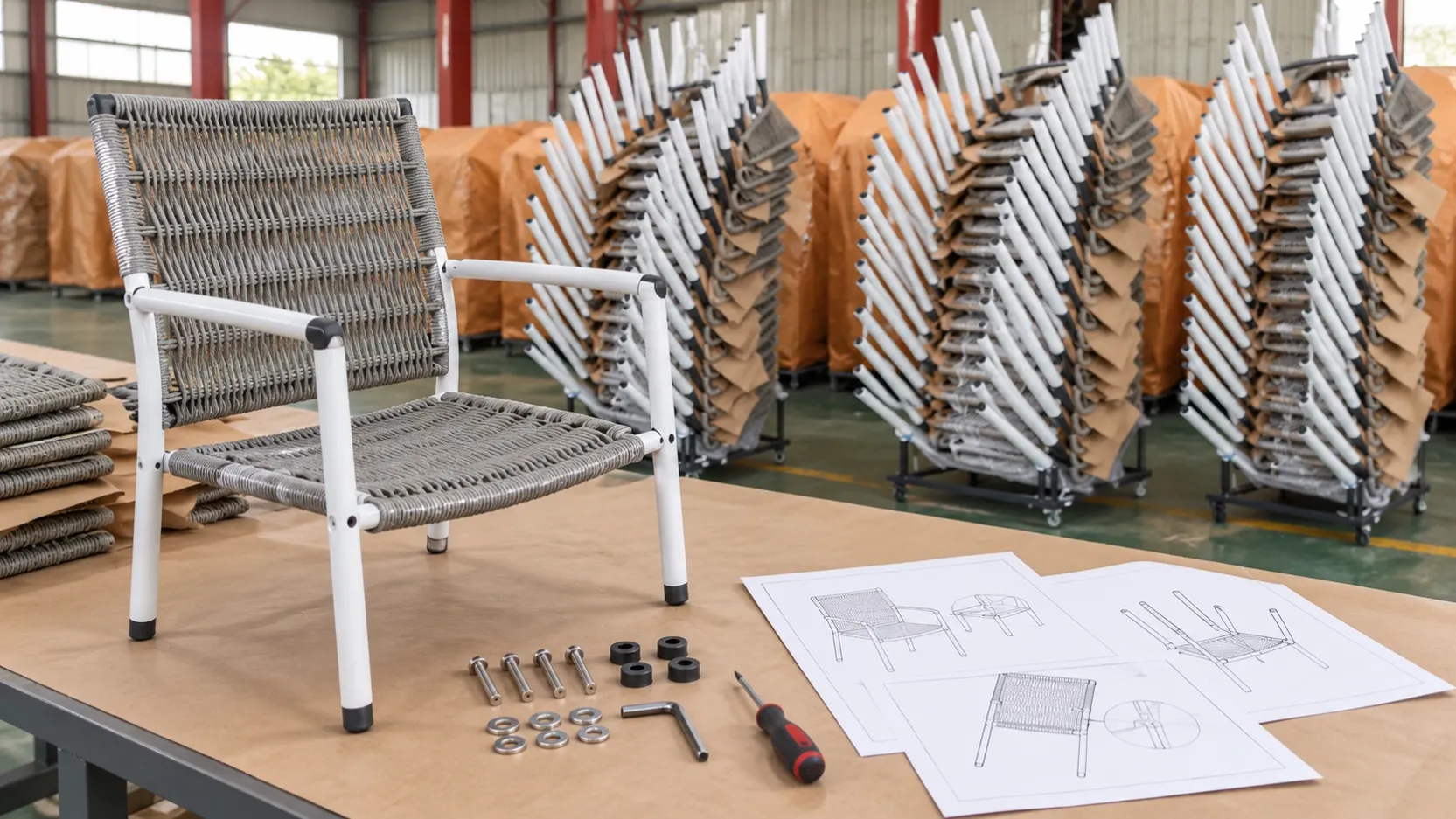
Review the exact instruction file against the exact packed model. A clear manual should identify the product and revision, show every included part and required tool, present an unambiguous sequence, and explain how the assembler confirms that the result is complete and correctly assembled.
Confirm that the manual belongs to the packed product
Match the model, variant, document title, revision and date to the order record. If one manual covers several versions, it should make the differences visible. A familiar-looking drawing is not enough when hole positions, hardware or components differ.
Keep the approved manual with the product data and purchase record so sales, packing, receiving and installation teams use the same version.
Check the parts inventory before the first assembly step
The parts list should show each component and hardware group with an identifier and quantity. Separate similar fasteners by size or function. State which tools are included and which must be supplied by the assembler. Where a part has a left, right, front, rear, upper or lower orientation, show it before the sequence begins.
Compare the inventory with an actual packed set. A correct diagram paired with a different hardware pack still creates a failed installation experience.
Review the instruction file in a fixed sequence
| Section | Question to answer | Evidence |
|---|---|---|
| Identity | Does the file name the exact model, variant and revision? | Product label and controlled document record |
| Finished result | Can the assembler recognize the correct final orientation? | Clear full-product view |
| Inventory | Are all components, hardware quantities and tools shown? | Parts layout matched to a packed set |
| Sequence | Does each step show one clear action and required parts? | Numbered diagrams in physical order |
| Completion | How is correct and stable assembly checked? | Model-appropriate final checks and cautions |
| Revision | Can an outdated file be distinguished immediately? | Date, version and change record |
Remove visual ambiguity from every step
Use a consistent viewing angle, part identifiers and fastener symbols. Show where the action occurs and what changes after the step. Avoid placing several unrelated actions in one crowded illustration. If a component must remain loose until later, the sequence should say so clearly rather than relying on guesswork.
Text should support the drawing, not contradict it. Translate user-facing text through a controlled language workflow when the receiving market requires another language; do not assume diagrams eliminate every language need.
Test the instructions with the intended assembler
Ask someone who was not involved in creating the manual to assemble the exact product using only the supplied information and tools. Record pauses, wrong turns, missing quantities and steps that require verbal explanation. Revise the file and repeat the check when the product or hardware changes.
This is a documentation usability check, not a substitute for product safety assessment or trained professional installation where the product or site requires it.
Check packing, labels and document access together
Confirm that the instruction file is present in the agreed format, is associated with the correct carton or product, and remains readable after packing and transport. If a digital copy is used, ensure the access method and document revision are controlled. Do not let an old online file overwrite a newer order-specific record.
Use the carton-mark preparation guide to keep product and package identity aligned.
Record open documentation issues before release
List missing parts, unclear diagrams, translation questions and product differences by model. Give each issue an owner and status. Do not mark a manual approved merely because the furniture can be assembled by someone already familiar with it.
For order-level control, connect the final manual revision to the purchase order line-item record.
Common questions
Can one manual cover a whole furniture collection?
Only when the covered models and every relevant difference are explicit. Separate manuals are safer when components, hardware or assembly sequences differ.
Are pictures alone enough?
Sometimes they carry much of the sequence, but identity, quantities, warnings, tool requirements and completion checks may still require controlled text or symbols.
Should a buyer review the actual hardware pack?
Yes. The document and one representative packed set should be compared so identifiers, quantities and tools match.
What happens when a component changes?
Update the product record, instruction revision and any affected parts or packing references before the changed version is released.
Include documentation requirements in the RFQ
State the shortlisted model, receiving market, intended assembler, required document format and any language or installation constraints. DM Furniture can clarify what current product information is available and which documents require confirmation for the selected model.
Send your model and documentation questions
Start with the outdoor furniture product directory when preparing a shortlist.
Further reading
The ISO/IEEE 82079-2 draft describes principles for product identity, inventory, assembly steps and confirmation of correct assembly. Applicability should be reviewed for the product, audience and market.