Sep 2, 2026Buying Guides
How to Source Outdoor Dining Furniture for Commercial Projects
Compare outdoor dining chairs and tables by application, layout, material, handling, maintenance and sample approval before requesting a commercial furniture quotation.

Direct answer
Source outdoor dining furniture as a coordinated operating system, not as unrelated chairs and tables. Start with the service environment, occupied layout, table format, cleaning routine, moving or stacking frequency and storage plan. Then compare chair dimensions with table height and apron clearance, confirm materials and finishes in writing, and approve one complete chair-and-table combination before production. A good RFQ separates required details from preferred appearance and asks the supplier to identify every unconfirmed item. This makes quotations easier to compare and reduces mismatches between visual references, product construction and the final commercial dining layout.
Questions to answer before selecting models
- Is the furniture for a restaurant terrace, cafe, hotel dining area, resort, retail program or another use?
- Will the area be covered, partially covered or fully exposed?
- How many seats and service zones are planned?
- Which table formats and party sizes are required?
- Will staff move, stack or store the chairs every day?
- Is armchair clearance important around the chosen table base and apron?
- Are cushions operationally practical for the cleaning and storage routine?
- Which materials, finishes and colors are fixed, and which may be proposed?
- What sample, swatch or marked-photo approvals are required?
- Which local accessibility, fire, circulation and outdoor-space rules must the project team review?
Build the schedule by operating zone
Restaurant terraces and hospitality dining areas rarely operate as one undifferentiated space. Separate the entrance, primary dining area, bar or counter zone, lounge edge and flexible-event area. Record the expected chair type, table type, quantity and operating requirement for each zone.
Zone — Buyer decision — Operational question
Primary dining — Dining chair and table combination — Does the occupied layout support service circulation?
Flexible terrace — Movable or stackable seating direction — How often will staff reset or store the furniture?
Bar or counter — Bar-height chair and matching table — Are seat and table heights confirmed as one combination?
Accessible seating — Table and clear-space requirement — Has the responsible local project team approved the layout?
Waiting or lounge edge — Lower seating and side tables — Is this a dining function or a separate comfort zone?
The schedule should show the model or reference image, quantity, required finish, table pairing, cushion requirement, destination and every open question. Do not combine several visually similar chair versions under one model number.
Match chairs and tables before approving the collection
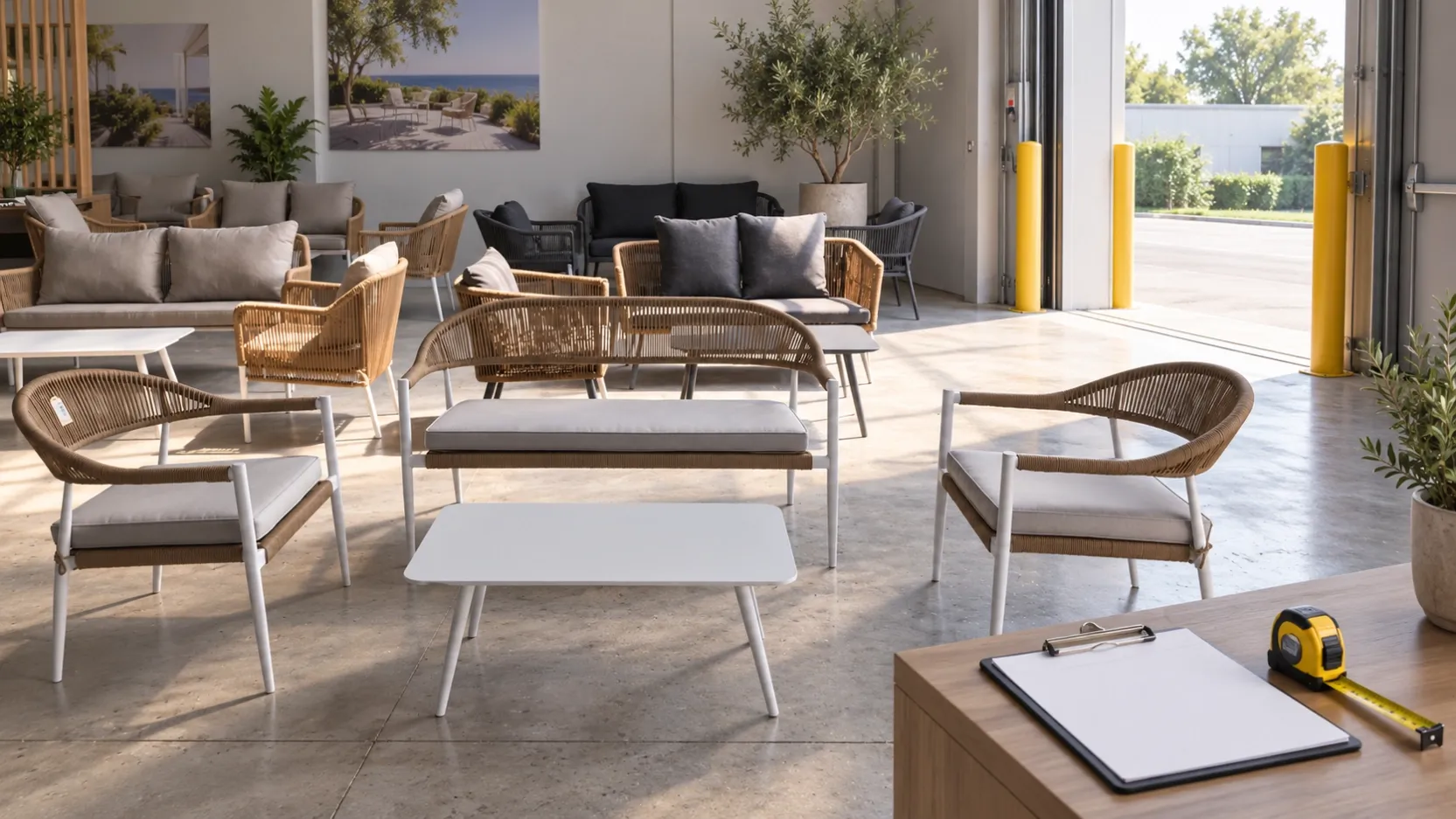
A chair can look suitable in isolation and still conflict with the table. Ask for confirmed product dimensions and review the actual chair-and-table combination, including:
• seat height relative to the tabletop;
• arm height relative to the table apron or underside;
• chair width and usable spacing between table legs;
• occupied depth and pull-out space;
• table-base position and guest legroom;
• floor contact points and stability on the intended surface;
• the number of seats shown in the proposed layout.
Do not infer these relationships from a styled photograph. Product images are useful for appearance, but the buyer needs confirmed model records and dimensions before approving the layout.
Compare construction by operating requirement
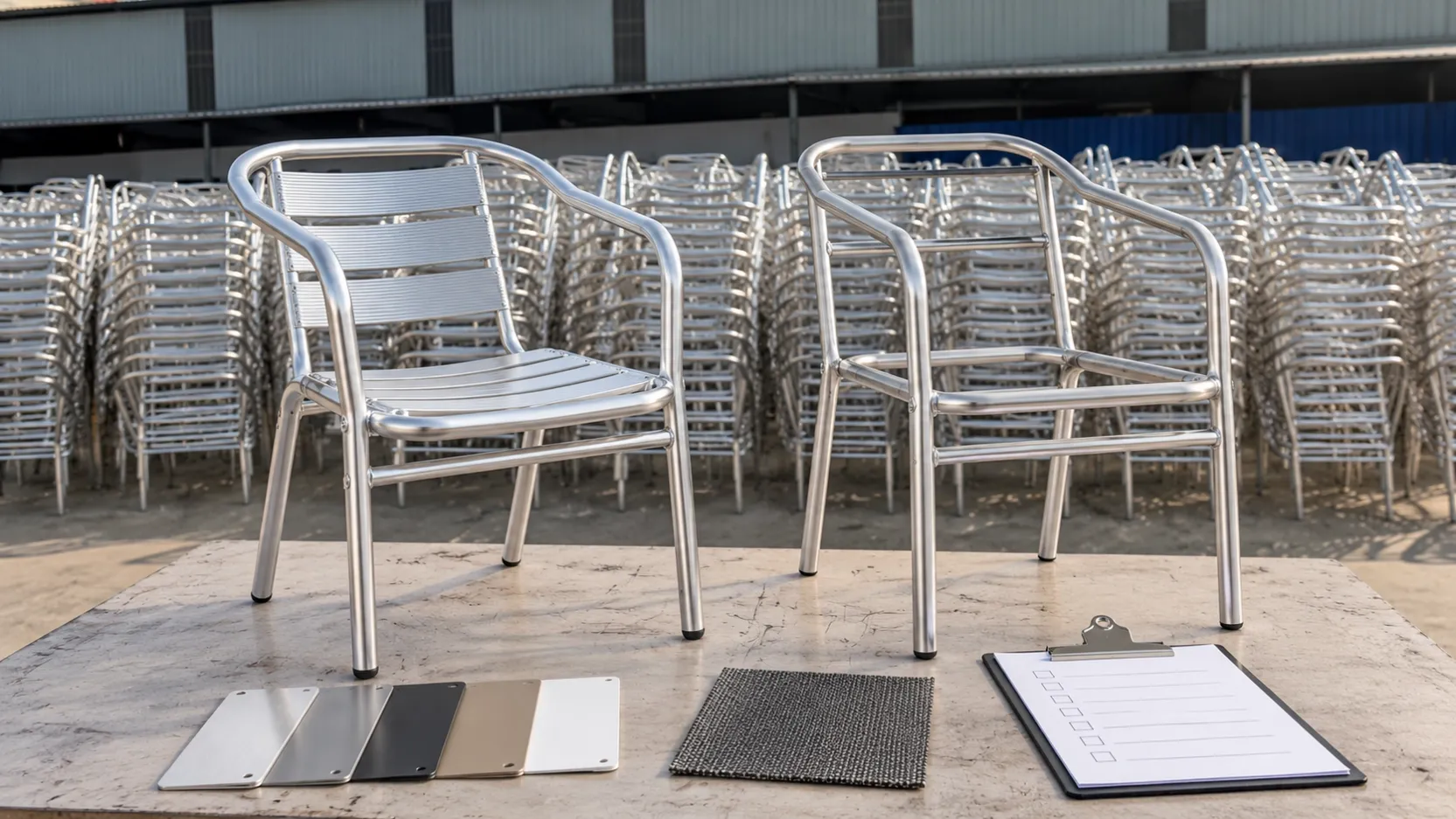
Outdoor dining collections may use aluminum frames with rope, rattan-style weaving or Textilene surfaces, while outdoor tables may use aluminum, steel or other confirmed constructions. These are category examples, not a statement that every model uses the same materials.
Review area — What to confirm — Why it matters
Frame — Material, structure, finish and visible connection details — Prevents visually similar models from being treated as identical
Seat and back — Rope, rattan, Textilene or other confirmed surface — Affects appearance, handling and maintenance questions
Tabletop — Confirmed material, edge, attachment and care instructions — Tabletop assumptions can change the complete quotation
Cushion — Included or optional, fabric direction and storage plan — Clarifies scope and daily operation
Floor contact — Glides, feet and replacement identification — Supports floor protection and future maintenance planning
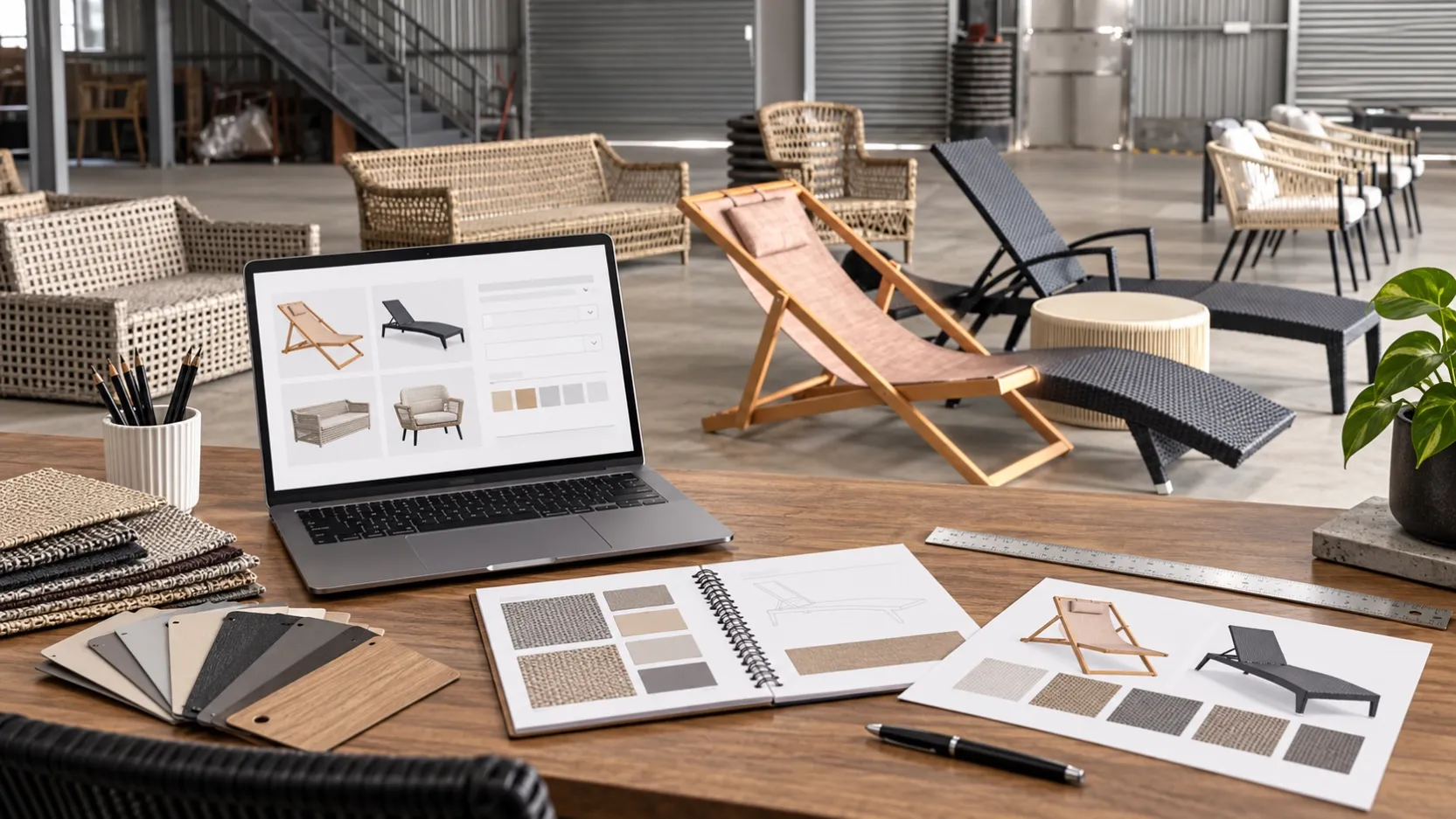
Finish — Approved color reference and sample method — Reduces color interpretation from screens or inspiration photos
Review the outdoor furniture material guide: https://www.dmfurnitures.com/blog/outdoor-furniture-material-notes-b2b-buyers before writing the final material requirement. A material name alone does not confirm grade, thickness, coating system, color, care method or performance.
Plan for moving, stacking and storage
If staff will reset the terrace every day, handling is part of the product decision. Ask the supplier to confirm whether the exact model is stackable; do not assume stacking from category language or a similar chair image. Review the approved sample for grip points, contact areas, stacked stability and the risk of finish-to-finish rubbing.
For seasonal storage, record the available doorway, route, storage footprint and identification method. Cushions and removable components may need a separate dry-storage plan. The stackable outdoor dining chair guide: https://www.dmfurnitures.com/blog/stackable-outdoor-dining-chairs-restaurant-terraces can be used as a second-stage checklist, but model-specific stacking details still require confirmation.
Review cleaning and maintenance before color approval
Ask the operator how frequently tables and chairs will be cleaned, which products are used and where cushions will go during rain or closing hours. Then request the supplier's care instructions for the proposed materials. A pale finish, open weave or upholstered component may be visually appropriate, but the operating team must decide whether the planned cleaning and storage routine is realistic.
The final specification should identify the approved color reference, visible surface, replacement components and care notes. Avoid unsupported phrases such as easy maintenance unless a defined material and procedure support the statement.
Sample and approval sequence
Approve one complete dining combination rather than reviewing only a chair image. A practical sequence is:
- Confirm model numbers and the intended chair-and-table pairing.
- Review written construction and material records.
- Approve color and surface samples.
- Check the physical sample or agreed evidence against the schedule.
- Review occupied layout, table clearance and staff handling.
- Record approved photos, dimensions and open changes.
- Confirm packing, labeling and commercial details separately for the order.
Unconfirmed MOQ, lead time, loading quantity, warranty, testing and certification stay as order-specific questions. They should not be copied from another model or project.
Common sourcing mistakes
Mistake — Risk — Better approach
Selecting chairs before tables — Arm, apron or leg-clearance conflict — Approve the exact pairing
Using one inspiration photo as the specification — Construction and dimensions remain undefined — Separate appearance reference from required facts
Assuming every chair is stackable — Handling or finish damage — Confirm the exact model and review a sample
Comparing unit prices without scope — Cushions, finishes or table components differ — Compare included components and assumptions line by line
Ignoring occupied circulation — The visual layout may not work in service — Review the plan with the responsible local team
Publishing estimated logistics as facts — Buyer decisions rely on unverified data — Confirm order-specific packing and delivery information
Current category paths for an RFQ
• Outdoor dining chairs: https://www.dmfurnitures.com/outdoor-dining-chairs• Outdoor tables: https://www.dmfurnitures.com/outdoor-tables• Outdoor bar chairs: https://www.dmfurnitures.com/outdoor-bar-chairs• Commercial outdoor furniture applications: https://www.dmfurnitures.com/applications• Outdoor furniture RFQ checklist: https://www.dmfurnitures.com/blog/how-to-prepare-outdoor-furniture-rfq
The category pages are shortlisting tools. Product facts must come from the confirmed model record used for the quotation.
Buyer checklist
• Buyer type, project and destination are stated
• Dining zones and quantities are separated
• Every chair and table has a model or marked reference
• Chair-and-table height and clearance will be confirmed
• Occupied circulation has been reviewed locally
• Moving, stacking and storage routines are described
• Frame, surface, tabletop and cushion scope are written
• Required and preferred details are separated
• Color and material approval method is defined
• One complete dining combination will be reviewed
• Care and replacement records are requested
• MOQ, lead time, packing, testing and warranty remain confirmation items
FAQ
Should buyers select dining chairs or tables first?
Develop them together. The exact pairing determines arm clearance, guest spacing, table-base legroom and the occupied layout.
Is a stackable chair always better for a restaurant terrace?
No. Stackability is useful only when the exact model, staff routine and storage plan support it. Comfort, construction and layout still matter.
Can one finish be used across dining and bar seating?
It may be possible, but the buyer should approve physical color or material references and record each model separately. Screen images are not reliable finish standards.
What should be included in a dining furniture RFQ?
Include zones, models or references, quantity by line, chair-and-table pairing, required materials and colors, cushion scope, destination, handling routine and open confirmation questions.
Does DM Furniture publish fixed MOQ or lead time for every model?
No fixed value is stated in this article. Request order-specific information for the shortlisted models and quantity.
RFQ CTA
Send an outdoor dining furniture RFQ: https://www.dmfurnitures.com/contact-us with the application zone, chair and table models or reference images, estimated quantity by line, preferred materials and colors, destination, and required approval steps.
External sources
• U.S. Access Board outdoor dining, retail and community spaces webinar: https://www.access-board.gov/webinars/2025/05/01/outdoor-dining-retail-and-community-spaces/• U.S. Access Board accessible routes guide: https://www.access-board.gov/files/ada/guides/accessible-routes.pdf• Google people-first content guidance: https://developers.google.com/search/docs/fundamentals/creating-helpful-content
Accessibility sources are included to prompt review by the responsible local project team. They are not a claim that U.S. requirements apply to every market or that a DM Furniture product is certified for a specific project.